A renewable energy-based energy system could save Europe €1.6 trillion by 2050
Europe could save €1.6 trillion by 2050 if it builds its energy system with a high share of renewable energy sources (RES). This is the conclusion of a new large-scale study by the European wind energy association WindEurope, prepared in cooperation with Hitachi Energy.
The analysis shows that even when additional costs for electricity grid development, energy storage and backup supply are taken into account, an energy system based on renewable energy remains the most cost-effective option available. The study is clear: delaying the energy transition and lowering climate ambitions does not bring economic benefits either.
Five scenarios for Europe’s energy future
The study compares the total system costs of five energy scenarios for Europe up to 2050. The first four pathways — Renewables+, Nuclear+, Hydrogen+ and CCS+ — foresee reducing greenhouse gas emissions in the EU by at least 55% by 2030, 90% by 2040 and achieving climate neutrality by 2050.
The “Slow Transition” scenario reflects a slower pace of decarbonisation, as the name suggests, assuming a 77% reduction in greenhouse gas emissions by 2040 and 90% by 2050, without reaching climate neutrality.
The scenarios include:
- Renewables+ – a system based primarily on renewable energy sources
- Nuclear+ – a system with a large share of nuclear power
- Hydrogen+ – hydrogen as a key energy carrier
- CCS+ – carbon capture and storage (CCS)
- Slow Transition – a slower decarbonisation pathway in which the EU does not achieve climate neutrality
Renewables – the most cost-effective choice
The results show that the Renewables+ scenario is the most cost-effective pathway. Scenarios relying more heavily on nuclear power, hydrogen or carbon capture and storage (CCS) would be more expensive than the renewable-based scenario.
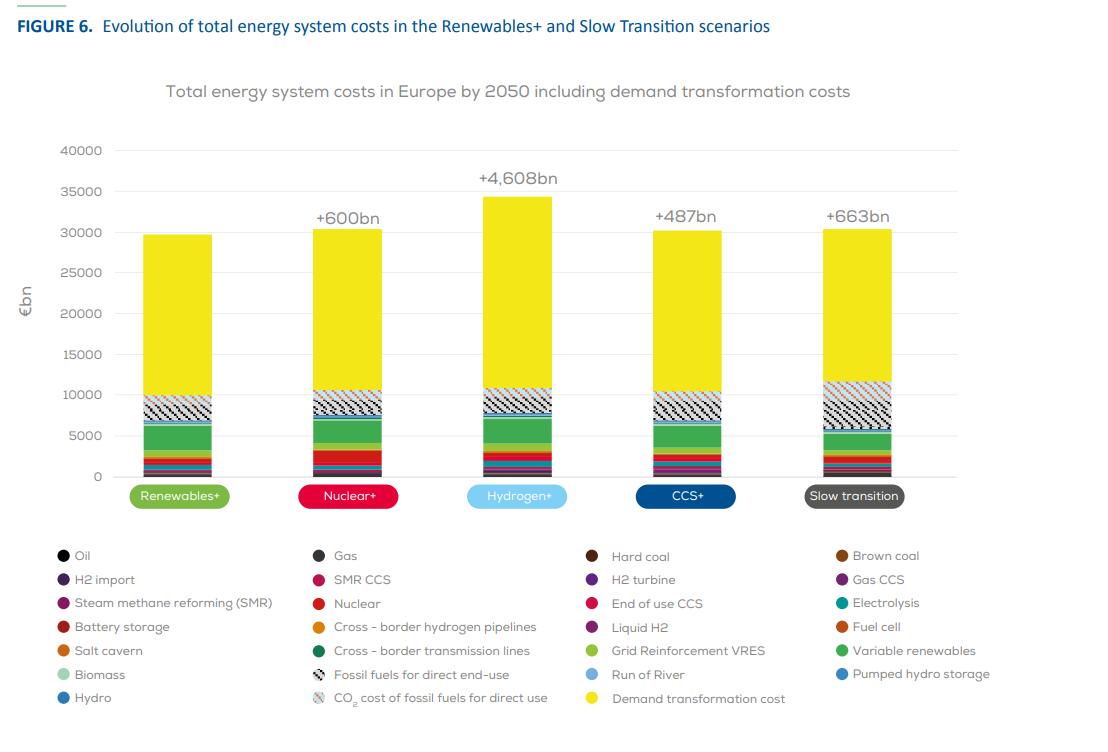
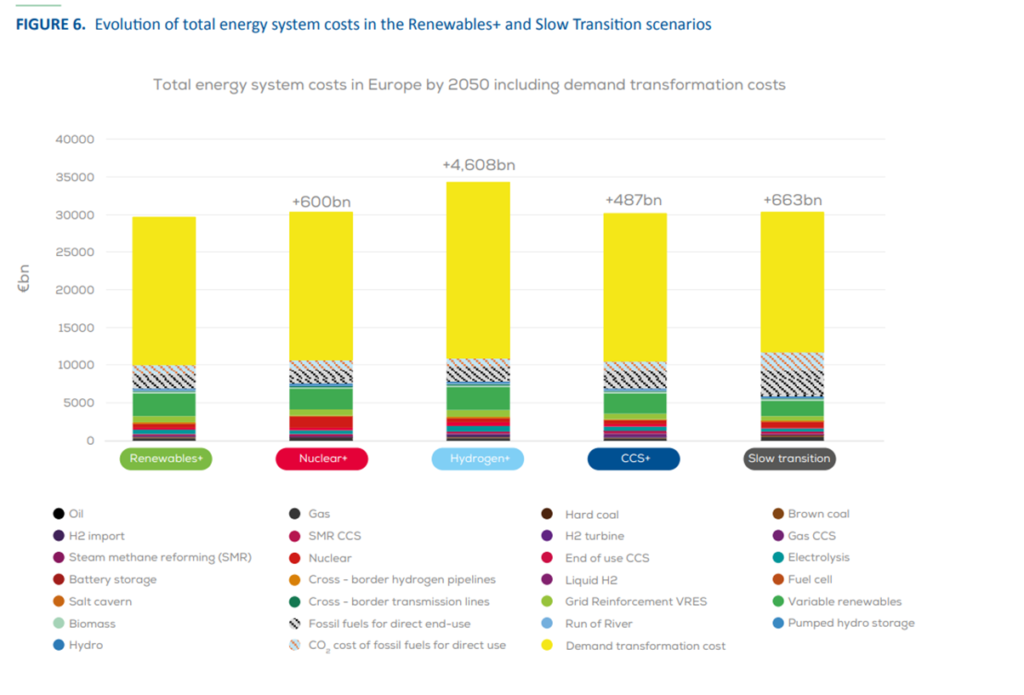
By 2050, the cost differences range from €487 billion to €860 billion compared to the Renewables+ pathway.
Compared to the “Slow Transition” scenario, an energy system based on renewable energy sources is:
- 1.1% more expensive in 2030, but costs decline sharply afterwards;
- €331 billion cheaper already by 2035;
- €1.6 trillion cheaper by 2050.
Total energy system costs
Figure 4 presents the total energy system costs for Europe up to 2050 across all scenarios. It clearly shows that the Renewables+ scenario is the most cost-effective pathway.
The Nuclear+, CCS+, and Hydrogen+ scenarios result in €487–€860 billion higher total costs. The “Slow Transition” scenario leads to €1.637 trillion higher total system costs compared to Renewables+ by 2050.
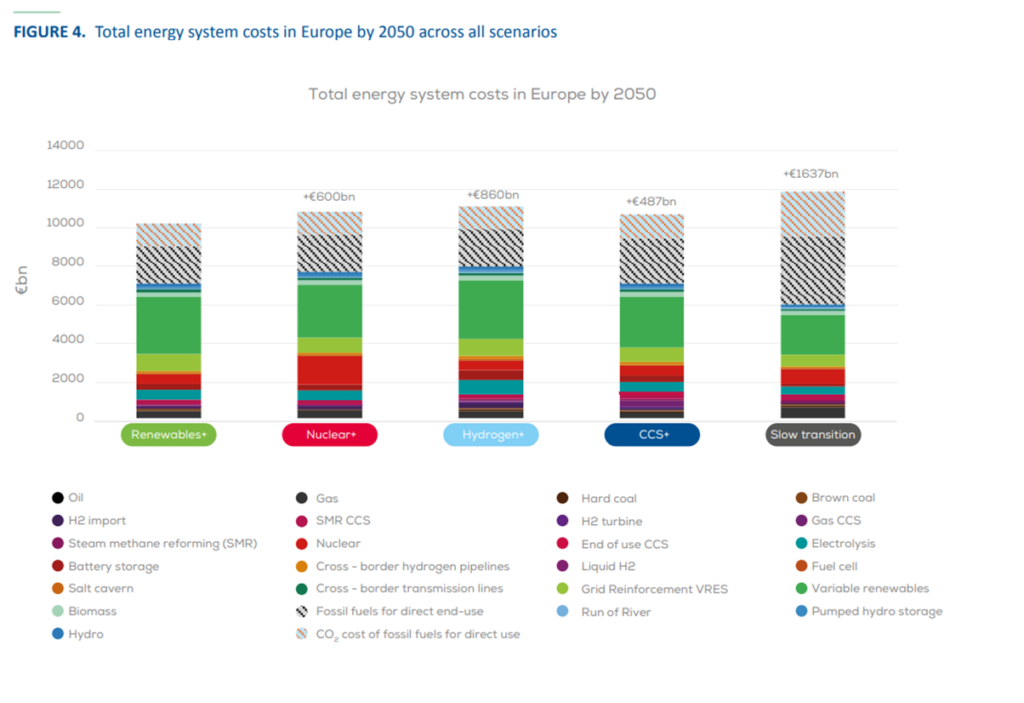
Figure 5 also tracks the change in total energy system costs between the Renewables+ and Slow Transition scenarios for the period 2030–2050. In 2030, the Slow Transition scenario is 1.1% cheaper, but shortly afterward its costs increase, and before 2035 they exceed those of Renewables+.
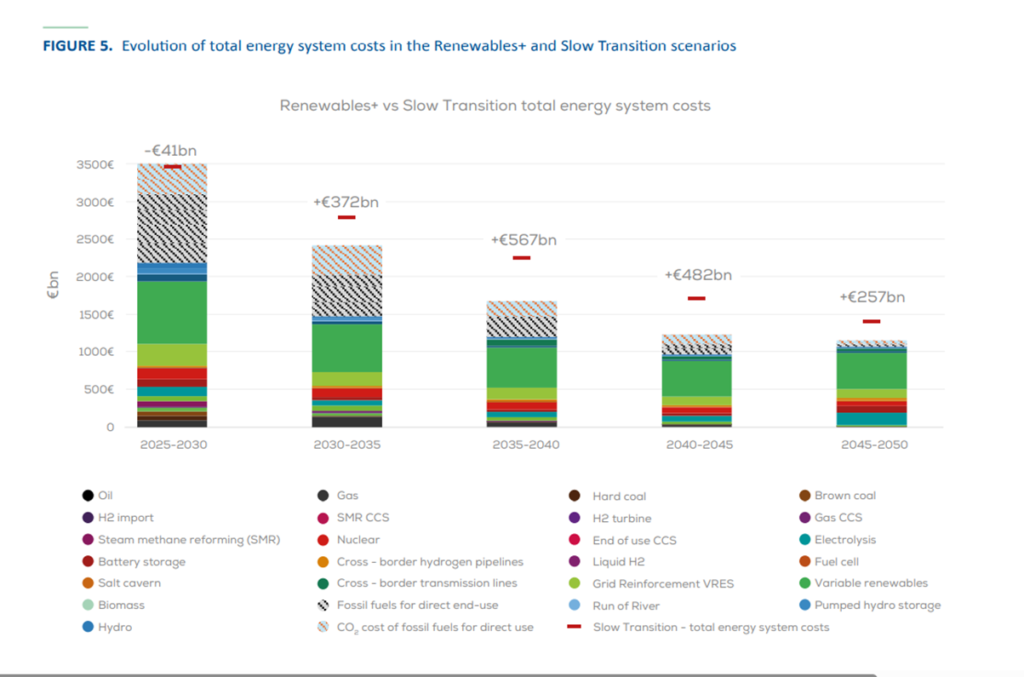
Despite the increased investment needs in electrification, generation, grids, and energy storage in the net-zero emissions scenarios compared with a slower decarbonization scenario, as shown in Figure 5, even after accounting for the costs of this transformation, the renewables-based pathway remains significantly cheaper. Compared with “Slow Transition,” Renewables+ is €217 billion cheaper by 2040 and €663 billion cheaper by 2050.
Wind power remains a key technology across all energy scenarios
With regard to variable renewable energy sources, onshore wind shows the smallest differences in total installed capacity across all scenarios. In the Nuclear+ and CCS+ scenarios, onshore wind capacity in 2050 is only 2–2.5% lower than in Renewables+, while in Hydrogen+ it is even 7.6% higher.
Figures 11 and 12 show how the electricity generation mix evolves across all scenarios during the 2030–2050 period.
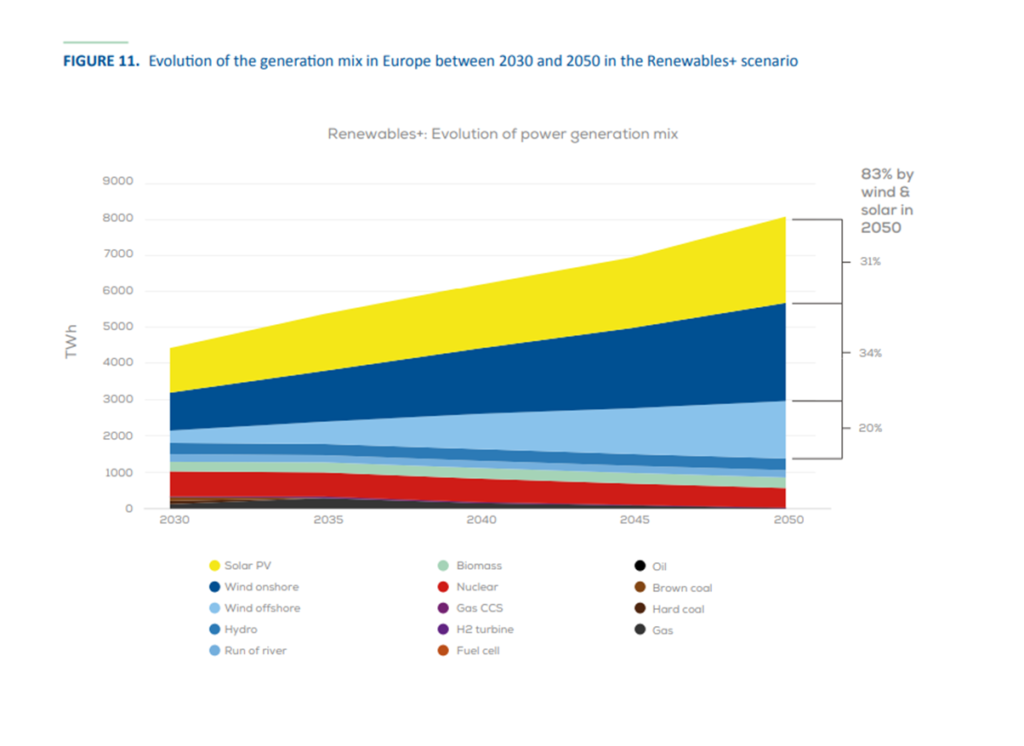
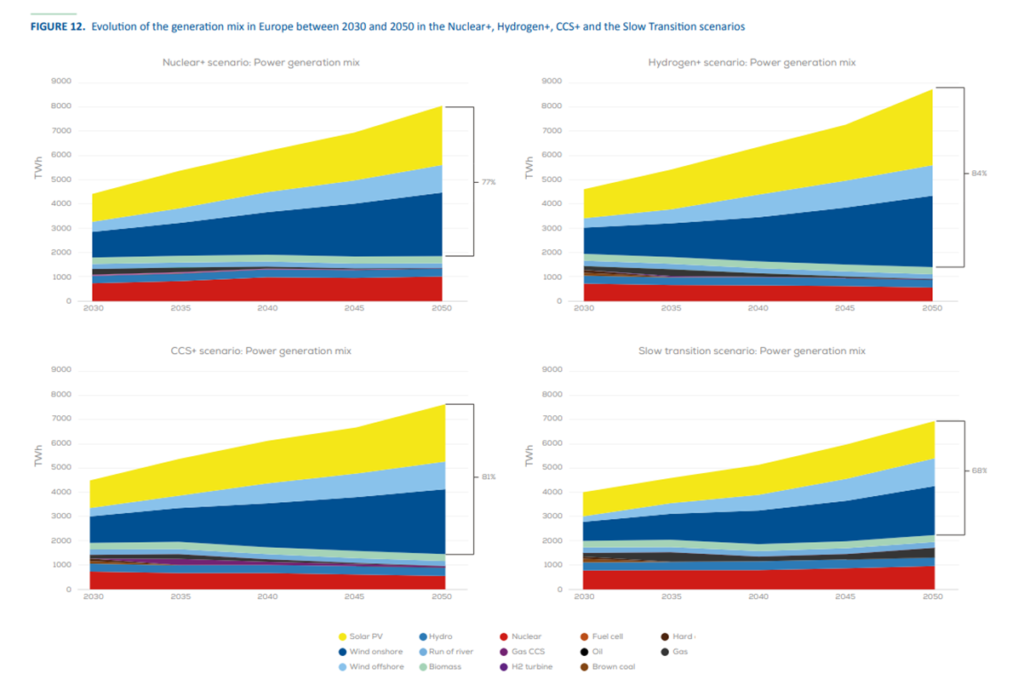
By 2050, the share of variable renewable energy sources in the electricity mix is similar across the Renewables+, Hydrogen+, and CCS+ scenarios—83%, 84%, and 81%, respectively. In the Nuclear+ scenario, this share decreases to 77%, while in the Slow Transition scenario it drops to 68%.
In the Renewables+ scenario, wind power provides 54% of total electricity generation in 2050—34% from onshore and 20% from offshore wind capacity, while solar photovoltaic energy contributes 31%.
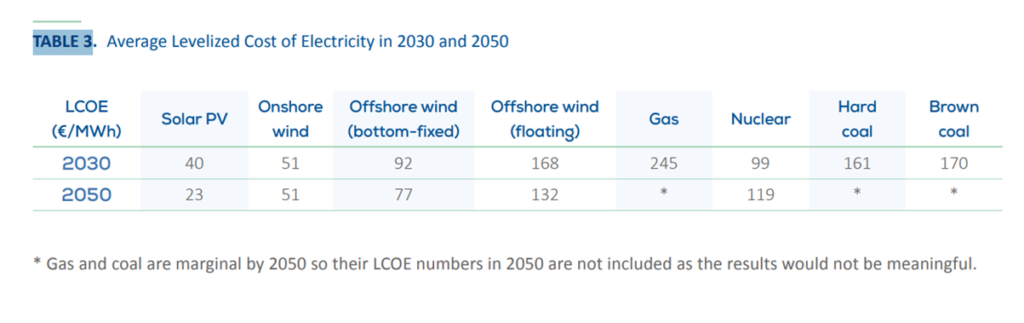
Table 3 presents the results of the analysis of the average levelized cost of electricity (LCOE) for the different technologies and countries in 2030 and 2050 under the Renewables+ scenario.
Greater security, lower import dependence
In addition to having the lowest costs, an energy system with a high share of renewable energy is also more secure and resilient to external shocks. By 2050, energy fuel imports under this scenario fall to 22% of total energy consumption, compared with 54% under the “Slow Transition” scenario.
The “Slow Transition” scenario leaves Europe in a particularly vulnerable position—with 78% import dependence in 2030, which decreases only partially by 2050.
Economic growth and new jobs
The energy transition toward renewable sources also brings significant socio-economic benefits. Currently, 440,000 people work in the European wind industry, and this number is expected to exceed 600,000 by 2030.
The conclusion is clear: rapid deployment of renewable energy sources is not only the best climate choice, but also the most economically rational one for Europe. The coming years will be crucial for building on this proven success.
It is important to note that the analysis does not assess or include other energy-system costs related to climate damage, biodiversity loss, health impacts, pollution, and economic, social, and political instability resulting from the use of fossil fuels. There is a substantial body of modern technical analyses that shed light on these issues.
Recommendations
To realize as quickly as possible the benefits and savings of a renewables-based energy system, the EU and national governments should:
- Invest heavily in the development of electricity transmission networks through better strategic planning, anticipatory investments, and more efficient management of grid connection queues.
- Accelerate permitting for renewable energy projects by implementing the EU’s new rules and digitalizing procedures.
- Reduce investment risk in wind energy through a stable schedule of bilateral Contracts for Difference (CfD) auctions, improving access to financing and ensuring predictable revenues.
- Speed up electrification of energy consumption, using all available EU instruments, including the Industrial Decarbonisation Bank (IDB), and adhere to agreed policies for transport decarbonization.
- Harmonize taxation, encouraging consumers to switch to electricity and removing non-energy taxes and levies from electricity bills.
- Strengthen the European wind energy supply chain to increase strategic autonomy and support economic growth.
Additional information on the methodology
The analysis builds on the European Commission’s impact assessment for the EU’s 2040 climate target and the pathway to climate neutrality by 2050 (“Securing our future: Europe’s 2040 climate target and path to climate neutrality by 2050 – building a sustainable, just and prosperous society,” 2024).
For the four scenarios in which gross greenhouse gas emissions fall to net zero by 2050, the assumptions are based on the European Commission’s mid scenario (S2), which assumes accelerated electrification, strong growth of renewable energy, development of interconnections, energy storage, and demand management. In all five scenarios, the same level of final energy consumption is assumed as in the Commission’s S2 scenario.
The full document is available for download from the WindEurope website:
https://windeurope.org/data/products/energy-system-costs/