BGWEA: The Proposed Restrictions in the INECP Pose a Risk to the Investment Climate, Competitiveness, and the Energy Transition
The Bulgarian Wind Energy Association (BGWEA), which unites a significant portion of investors and operators of wind power plants in Bulgaria, expresses serious concern regarding the restrictions proposed in the Environmental Assessment Report and the Appropriate Assessment Report to the updated Integrated National Energy and Climate Plan (INECP 2024).
According to BGWEA, the proposed restrictions extend far beyond their impact on a single sector and put at risk the achievement of national and European energy and climate targets. They limit the opportunities for developing competitive clean electricity production and could weaken Bulgaria’s attractiveness for investments in energy-intensive manufacturing, data centers, green hydrogen production, and other high-tech industries.
BGWEA states: “The decisions to be made regarding the INECP will have an impact far beyond the energy sector. They will determine the extent to which Bulgaria remains attractive for new investments in the Bulgarian economy that could rely on competitive, clean, and affordable electricity. They will send a clear signal regarding the reliable functioning of the rule of law, which fulfills its international commitments. Therefore, we believe that all restrictions should be based on up-to-date scientific data, applicable legislation, and a thorough assessment of their economic consequences. Only in this way can we simultaneously protect the environment, ensure legal certainty, and support the sustainable development of the Bulgarian economy.”
Particularly concerning are the measures proposed in Section 6.2 of the Appropriate Assessment Report, which introduce broad spatial restrictions on the development of new wind energy projects. These extend far beyond the boundaries of the Natura 2000 network of protected areas and cover significant portions of the regions with the highest wind potential in Bulgaria, including Dobrudzha, the Eastern Rhodopes, and parts of the Burgas region, which are defined by municipal administrative boundaries rather than habitats with specific endangered biodiversity.
The scale of the proposed restrictions is presented in Figure 1. As can be seen, significant parts of the territories with the highest wind potential in Bulgaria are affected.
An additional cause for concern is that the proposed restrictions replicate measures from the National Renewable Energy Action Plan (2012–2020), which is no longer in force. According to BGWEA, using such a document as a basis for new restrictions raises serious questions regarding their legal justification and compliance with current European and national legislation.
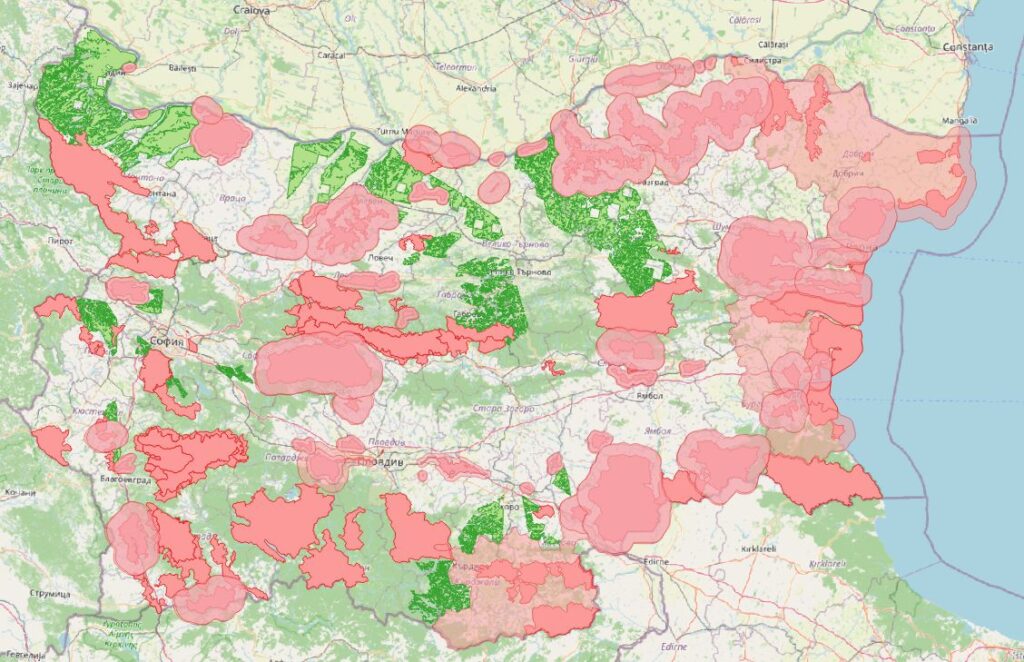
Figure 1. The proposed restrictions in the Appropriate Assessment Report to INECP 2024 affect a significant portion of the territories with the highest wind potential in Bulgaria.
During the public consultation process, reasoned position papers were submitted by BGWEA, other representative organizations from the energy sector, as well as a number of Bulgarian and international investors. Nevertheless, the reconciliation table published by the Ministry of Environment and Water (MOEW) shows that the objections to the proposed restrictions have essentially not been taken into account. As a result, a real risk is created that these restrictions will be included in the final Environmental Assessment Opinion to be issued by the Minister of Environment and Water.
BGWEA considers that the restrictions under discussion should also be viewed through the prism of the country’s long-term energy and industrial policy. Having sufficient local renewable electricity generation is a key factor in attracting new manufacturing, data centers, green hydrogen production, and other high-tech investments. Restricting the development of one of the most competitive local energy resources would diminish Bulgaria’s strategic advantage and, consequently, give an advantage to investments in neighboring countries with which we operate within a common energy market.
BGWEA calls on the competent institutions, prior to the adoption of the final Environmental Assessment Opinion on the INECP, to review the proposed restrictions in an open dialogue with the expert community and stakeholders. The Association is convinced that it is possible to achieve a balance between effective environmental protection and the creation of a predictable regulatory framework based on up-to-date scientific data and current legislation.
BGWEA’s official position papers on the Environmental Assessment Report and the Appropriate Assessment Report are available on the organization’s website.
The public hearing on the Environmental Assessment Report of the updated Integrated National Energy and Climate Plan (INECP 2024) is scheduled for August 31, 2026. https://www.moew.government.bg/bg/vajno-obyava-za-provejdane-na-obstestveno-obsujdane-na-doklad-za-ekologichna-ocenka-na-proekta-na-integriran-plan-v-oblastta-na-energetikata-i-klimata-na-republika-bulgariya-2021-2030-g-aktualizaciya-2024-g/