Wind Energy Can Provide Structural Stability for Bulgaria
Bulgaria has strong wind energy potential and growing investor interest, but wind power development has lagged behind due to lengthy permitting procedures, regulatory uncertainty, and limited market incentives.
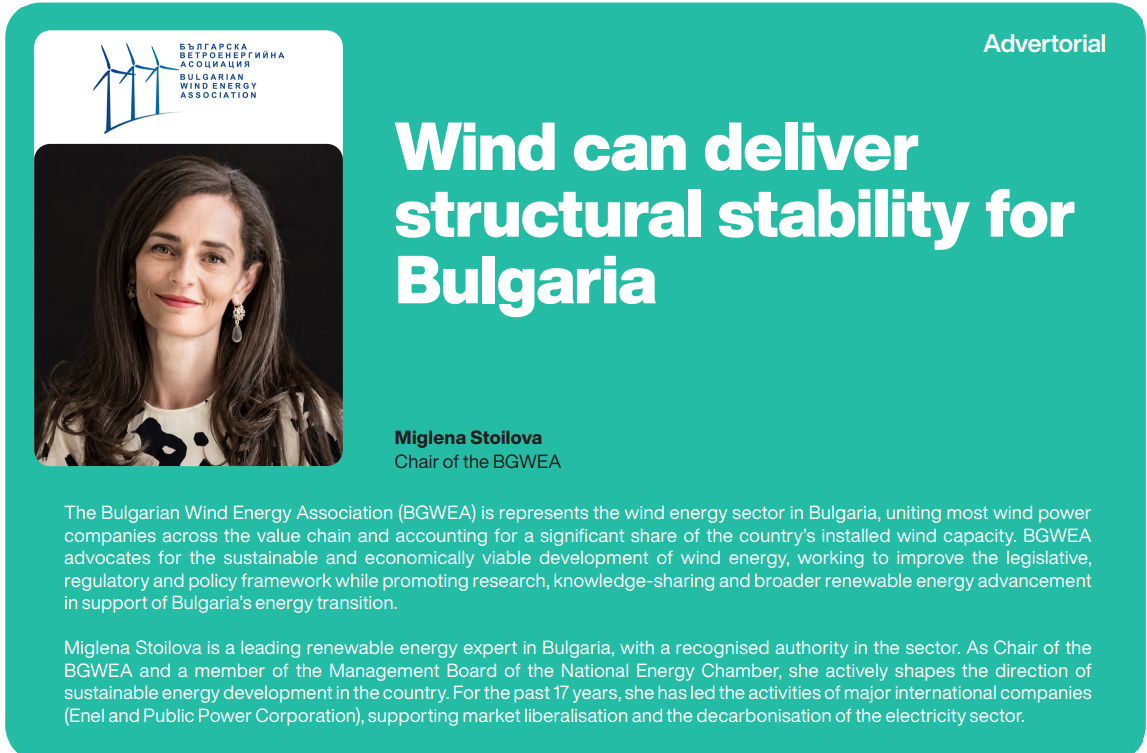
In an interview for Renewable Energy in Southeast Europe 2026, BGWEA Chair Miglena Stoilova emphasized that wind energy can play a key role in improving Bulgaria’s energy security, reducing electricity costs, and creating a more balanced renewable energy mix.
While solar power and battery storage have expanded rapidly in recent years, wind capacity has remained almost unchanged. As a result, Bulgaria has a much higher solar-to-wind ratio than the EU average and neighboring countries. Since wind and solar generation complement each other, increasing wind capacity would help improve system stability and reduce dependence on electricity imports and fossil fuels.
BGWEA members are currently developing around 4 GW of wind energy projects, with at least 3 GW potentially operational by 2030, provided that permitting procedures are streamlined, grid infrastructure is expanded, and a predictable regulatory framework is established.
According to Stoilova, wind energy should be seen not only as a climate solution but also as an important tool for strengthening Bulgaria’s energy independence, competitiveness, and long-term economic development.
We would like to thank SeeNext and Renewables Now for the invitation.
The full edition is available here:
Renewable Energy in Southeast Europe 2026 Edition