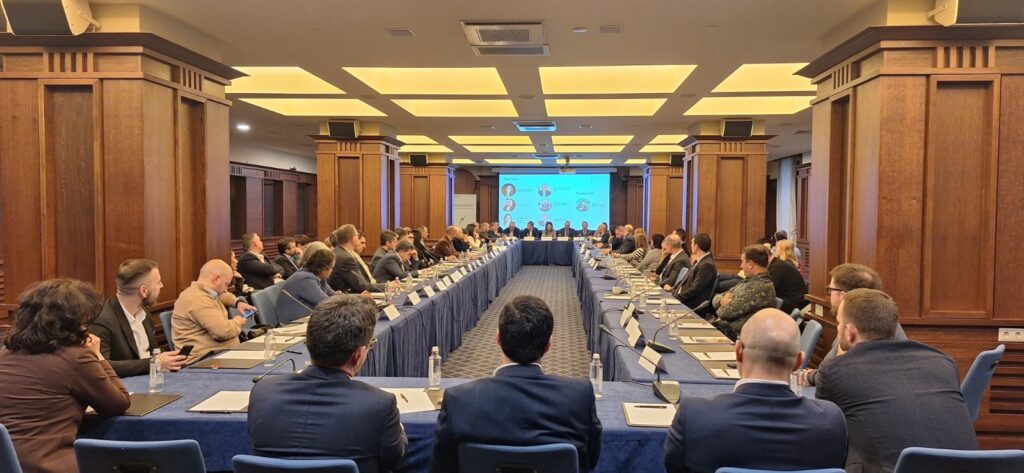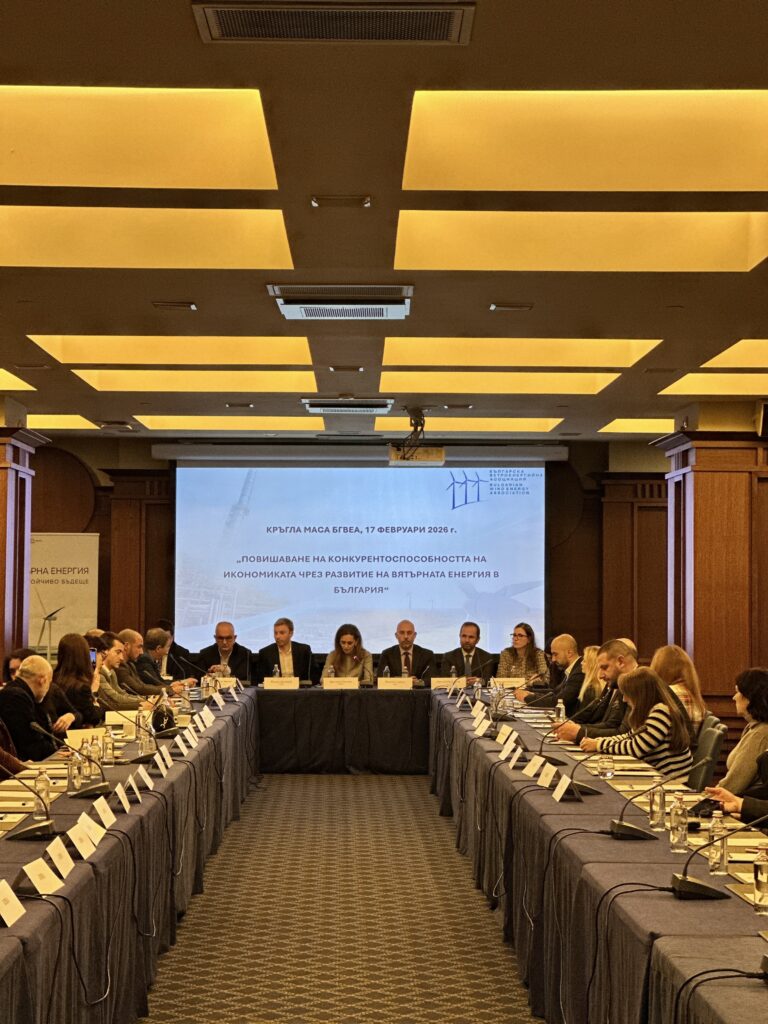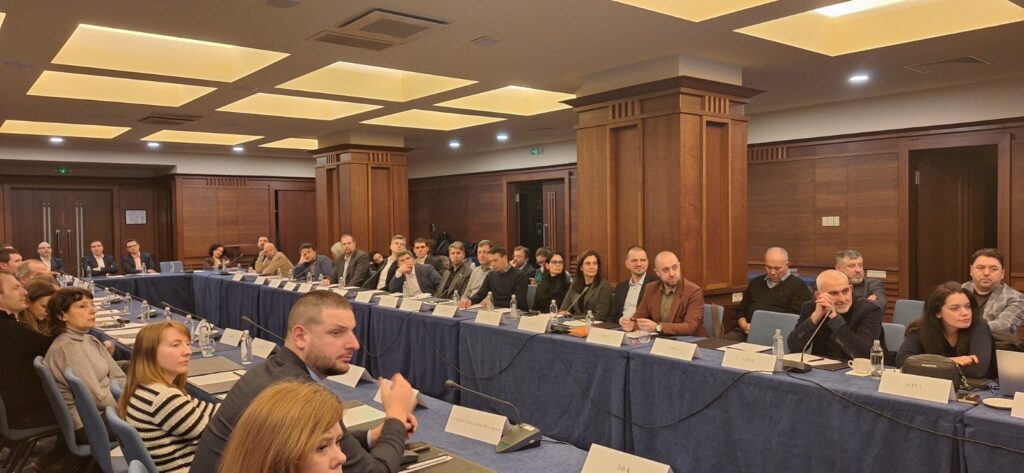
BGWEA Roundtable: “Enhancing the Competitiveness of the Bulgarian Economy through the Development of Wind Energy”
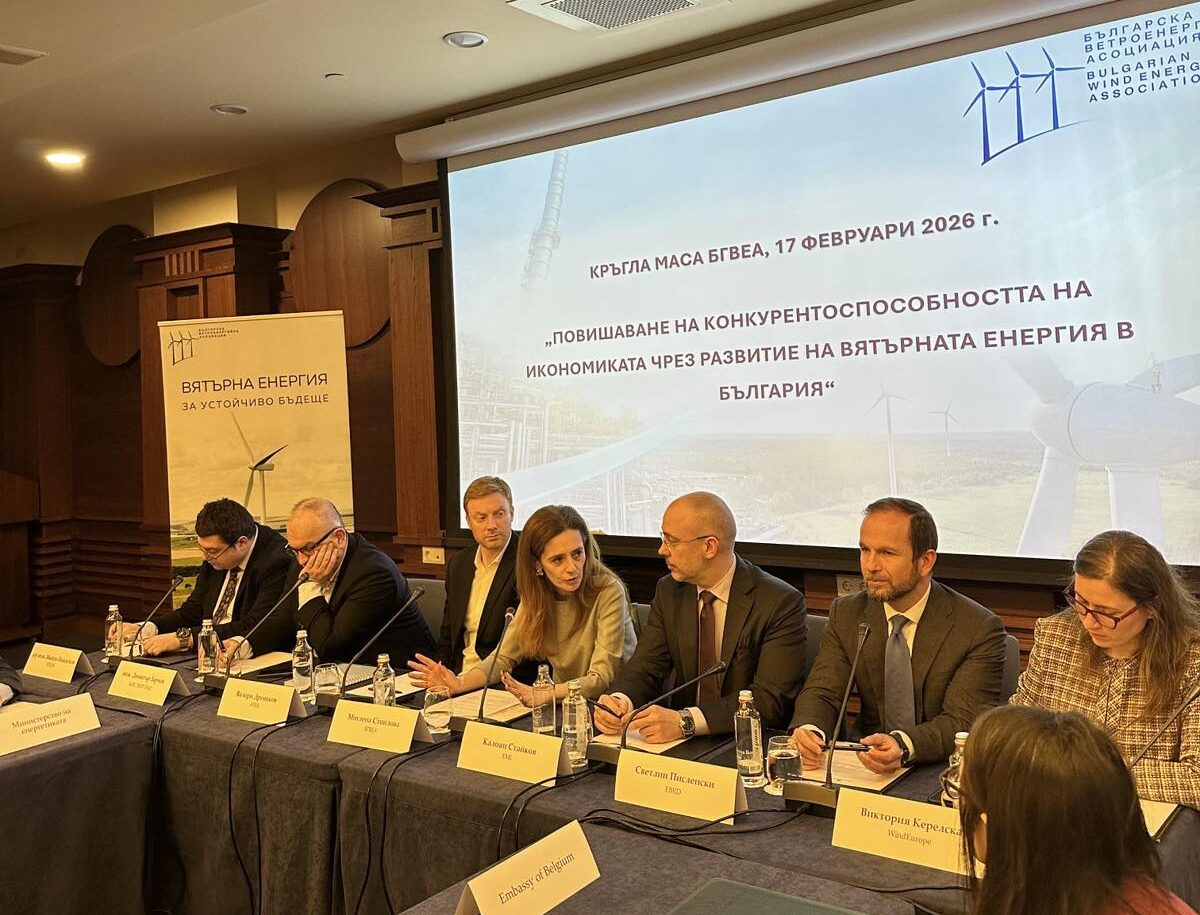
On 17 February 2026, the Bulgarian Wind Energy Association (BGWEA) brought together nearly 100 representatives of public institutions, the energy sector, industry, financial organisations and experts at a roundtable discussion titled “Enhancing the Competitiveness of the Bulgarian Economy through the Development of Wind Energy.”
The discussion was highly expert-driven and focused on practical solutions – how to unlock Bulgaria’s wind potential and accelerate investments through more efficient procedures, grid development, functioning market mechanisms and a predictable regulatory framework.
Wind is a resource that Bulgaria possesses – the question is whether we will turn it into an economic advantage. At a time when industry needs more predictable and competitive electricity prices, and when energy security and decarbonisation are among the country’s key priorities, wind energy is increasingly emerging as the “missing link” in Bulgaria’s energy mix.
Wind potential and real investment intentions – clear rules and a predictable environment are needed
The event was opened by Miglena Stoilova, Chair of BGWEA, who outlined Bulgaria’s position on the global wind energy map. She emphasised that wind power is already the second largest source of electricity in the European Union after nuclear energy, with around 236 GW of installed capacity and 18% share of electricity consumption in the EU in 2024.
Globally, the sector is growing even faster – China has more than 520 GW of wind capacity, while the United States has over 150 GW. Against this background, Bulgaria remains at only 0.71 GW installed capacity, representing about 3.5% of the national energy mix, lagging even behind countries in the region such as Greece (5.3 GW) and Romania (3.1 GW).
Wind energy is among the technologies with the lowest levelised cost of electricity (LCOE), significantly lower than conventional generation. This makes it a direct instrument for achieving more competitive electricity prices, greater energy security and a more sustainable foundation for industrial development.
In conclusion, Stoilova stressed that Bulgaria has excellent wind energy potential. Favorable meteorological conditions, strong average annual wind speeds and the availability of suitable land create real opportunities for large-scale development of the sector. This potential is already attracting serious investor interest and gives the country a chance to play a more significant role in the region’s energy transition.
BGWEA members are currently developing projects with a total capacity of around 4 GW, some of which are already at an advanced stage. This demonstrates that with clear rules and a predictable environment, the sector can develop rapidly and sustainably.
The system operator’s perspective and grid development as a key factor
Dimitar Zarchev, Head of the National Dispatch Centre at ESO EAD, presented the system operator’s perspective and emphasised that wind energy plays a key complementary role in the energy mix. It can provide renewable electricity during hours and seasons when solar generation is limited, including in the evening and during the winter months.
He also noted that a significant share of the currently installed wind capacity in Bulgaria consists of technologies installed around 15 years ago, meaning that modernisation and new projects would bring higher efficiency, better performance and greater contribution to the system.
To illustrate the imbalance in the pace of deployment of new technologies, he cited ESO data:
- From the end of 2024 to the end of 2025, new solar PV capacity increased from 4,568 MW to 5,984 MW (31% growth).
- Battery systems grew from 86 MW to 1,181 MW (over 1,280% growth).
- In contrast, wind capacity increased only from 711 MW to 716 MW (around 0.7% growth).
He also highlighted upcoming projects for grid infrastructure development, including the EU-funded CARMEN project in Northeastern Bulgaria – the region with the country’s best wind potential, where grid readiness will be crucial for accelerating new investments.
Demand for green energy is growing, but products are missing
Valeri Drenikov, Chair of the Association of Energy Traders in Bulgaria, emphasised that for traders wind energy is an important part of the energy mix puzzle and expressed strong expectations that wind will be the next wave of investment in Bulgaria.
The lack of sufficient wind capacity prevents the offering of a more stable “baseload-like” product. With portfolios currently dominated by solar generation, traders find it much harder to provide stable and long-term price offers to end customers, since short-term markets are highly volatile and strongly dependent on weather conditions – something that is not stable for either the economy or consumers.
He stressed that Power Purchase Agreements (PPAs) – direct long-term contracts between companies and producers – are the real mechanism that can provide greater predictability. However, in order to offer such long-term products from wind projects already developed in the country, it is necessary to remove existing legal restrictions (Article 100 of the Energy Act) that hinder the free trading of electricity by producers and limit the development of the necessary market products.
Non-market interventions and the lack of long-term products hinder competition
Kaloyan Staykov, Chair of the Energy Management Institute, focused on the need for a sustainable market environment and fewer non-market interventions that create uncertainty and distort the market.
While in the EU the balance between long-term contracts and short-term (“day-ahead”) trading is gradually being restored, Bulgaria still relies predominantly on short-term markets. When electricity prices for consumers are artificially fixed, there is little incentive to seek long-term products.
The compensation scheme introduced in Bulgaria in 2021 as a temporary response to extremely high electricity prices has effectively become permanent and, even more problematically, applies to all consumers regardless of their actual need.
Another major distortion is the revenue cap for producers, as revenues are taken from generators selling entirely on the free market without compensation when prices fall below the cap.
The European context: energy security, competitiveness and accelerated deployment
The event’s special guest, Victoria Kerelska from the European Wind Energy Association, placed the discussion within a broader European context.
She emphasised that the EU is now in a very different geopolitical situation compared to five years ago, with increasing focus on strategic autonomy, energy security and reducing risks for the European economy.
In the past week, European leaders reaffirmed that the Green Deal and the transition to decarbonisation are the only sustainable path to competitiveness, and that the development of renewable energy will remain a key priority because it delivers energy security, jobs and economic prosperity.
Kerelska noted that wind energy is expected to reach around 50% of electricity generation by 2050.
According to her, the solutions are already on the table: there is a European framework for accelerating wind energy deployment, but the key challenge for Bulgaria remains proper and timely transposition. This includes faster permitting procedures, where renewable energy projects are treated as being in the overriding public interest, with permits issued within two years.
As an example, she pointed to Germany, which after correctly transposing the rules issued permits for 20 GW of wind capacity in just one year and achieved significantly lower electricity prices.
She also highlighted the Contracts for Difference (CfD) mechanism – a topic that rarely appears in the Bulgarian public debate. In several European countries, CfDs are already used as a tool for reducing risk and accelerating wind energy investments.
Predictable revenues lower capital costs and electricity prices
Svetlin Pislenski, Associate Director at the European Bank for Reconstruction and Development (EBRD), emphasised that when projects have more predictable revenues – for example through long-term PPAs and/or Contracts for Difference (CfD) – financial costs for project development decrease.
This translates into a direct economic effect for the market, reducing the cost of electricity produced by projects and improving industrial competitiveness.
He gave examples from neighbouring countries such as Romania, where the bank advised the government in creating similar mechanisms that are already functioning successfully.
Bulgaria’s national targets
Representatives of the Ministry of Environment and Water and the Ministry of Energy emphasised that Bulgaria must triple its wind capacity in the next four years in order to meet the targets set in the National Energy and Climate Plan.
According to the plan, the country should increase its wind capacity to nearly 2 GW by 2030 and 5.5 GW by 2050. Achieving this will require accelerated sector development, supported by a clear and predictable regulatory framework, a stable investment environment and a long-term strategic vision for integrating new capacity.